


The Gila River once ran wide enough to float a boat through the Sonoran Desert. For more than a thousand years, the Pima farmed its banks in the punishing Arizona heat, coaxing tepary beans, squash, and corn out of ground that looked like it could grow nothing at all. Early explorers who passed through wrote of a lean, powerful people, farmers who could also run for miles. Diabetes, as far as anyone could tell, did not exist among them. Today, roughly half the adults in that same community live with type 2 diabetes, one of the highest rates ever recorded in any population on Earth.
What happened to the Pima in the space of a few generations is one of the clearest natural experiments modern medicine has ever stumbled into. And the thing that changed was not their blood. It was their food.
A thousand years of slow sugar
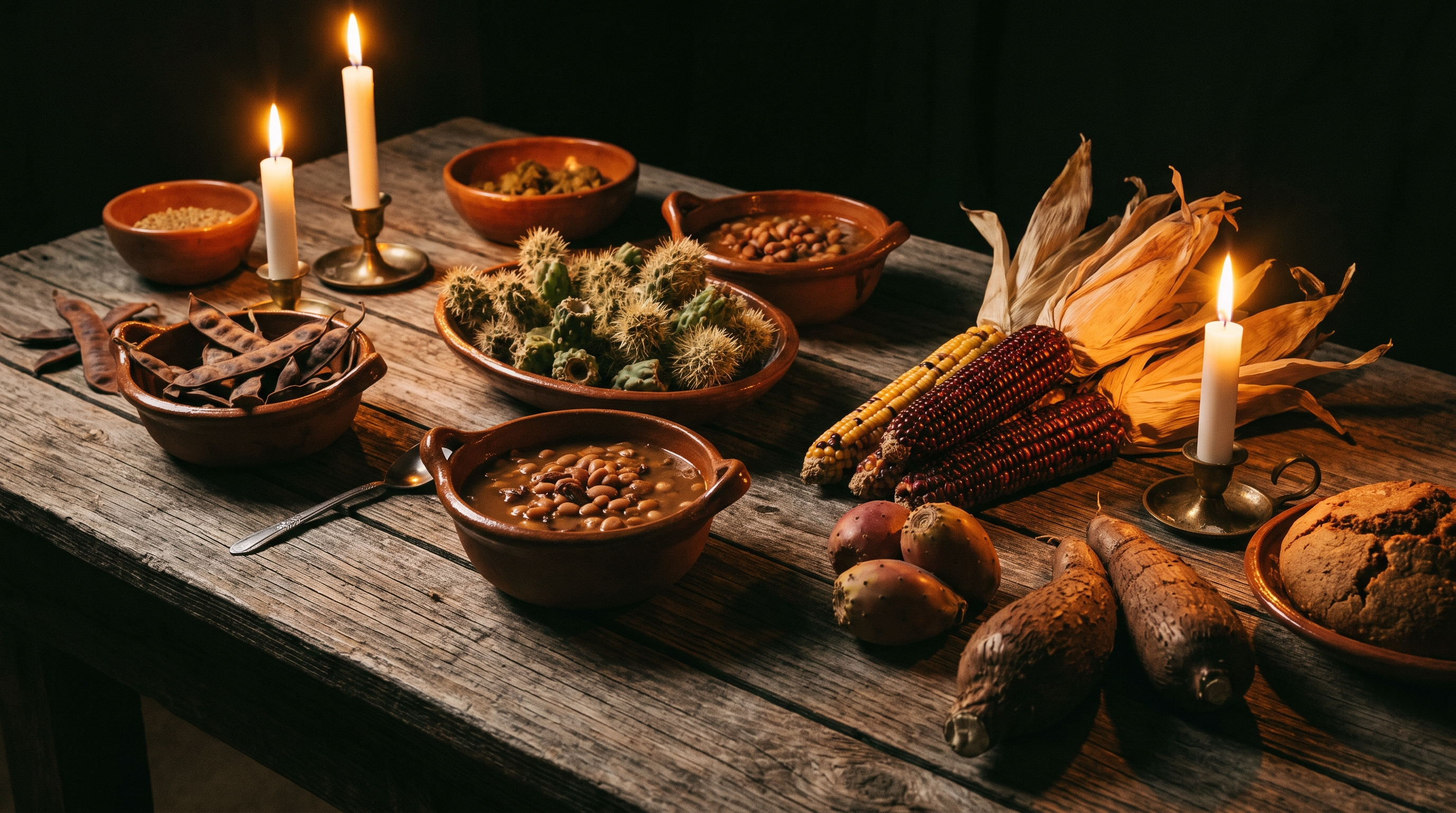
The old Pima diet was engineered by the desert itself. Tepary beans and mesquite flour, cholla cactus buds, acorns, wild greens, squash: foods that give up their sugars slowly, over hours, the opposite of a spike and crash. This was not health food by design. It was simply what the land offered, and the Pima built a thriving agricultural society on it, digging irrigation canals that impressed the U.S. Army officers who first mapped the region. They were not thin because they were deprived. They were thin because their food and their days demanded it.
The year the river stopped arriving
In the late 1800s, upstream settlers began damming and diverting the Gila. The water that had reached Pima fields for a millennium slowed, then stopped. Crops failed. A people who had always fed themselves faced hunger for the first time in living memory, a period Pima elders later remembered as the years of famine.
Into that vacuum came the federal government, and with it, food. Not the food their bodies had spent a thousand years adapting to, but boxes and cans built for shelf life: white flour, white sugar, canned meat, lard, and powdered milk. Commodity rations. The desert's slow sugars were replaced almost overnight by some of the fastest-digesting calories ever manufactured.
Grass-Fed Beef Organ Complex
The Pima thrived on nose-to-tail, nutrient-dense ancestral food. Our grass-fed organ complex (liver, heart, kidney, spleen & pancreas) delivers the same ancestral nutrition your great-grandparents ate, in one simple capsule.
Shop Organ Complex →The most-studied population on Earth
Within a single lifetime, a people who had scarcely known diabetes became the most diabetic community ever documented. The shift was so extreme that researchers from the National Institutes of Health arrived in the 1960s and, remarkably, never really left. What began as a survey became one of the longest continuous studies of diabetes in medical history, tracking the same families across decades.
The scientists looked everywhere a cause could hide: genes, metabolism, activity, insulin. For years the leading explanation was a so-called "thrifty gene," the idea that a metabolism built to survive famine turns ruinous in times of plenty. Susceptibility, they concluded, might well be inherited. But susceptibility is a loaded gun. Something else was pulling the trigger, and the sharpest evidence for what was several hundred miles to the south.
The proof across the border
Centuries earlier, a group of Pima had settled deep in the Sierra Madre mountains of Mexico. They never got the dam. No commodity boxes arrived at their doors. They kept farming the old way (beans, corn, squash) and kept working their bodies hard to do it. When researchers finally studied these Mexican Pima and compared them to their Arizona relatives, the contrast was staggering. Same ancestry, essentially the same gene pool. Yet the Mexican Pima stayed lean and carried only a small fraction of the diabetes burden. The variable that differed was not written in DNA. It was on the plate, and in the work of the day.
It was never only the genes
The Pima are not an isolated tragedy. They are the clearest chapter in a story that has repeated wherever ancestral food gave way, fast, to refined flour, sugar, and industrial fat: among Indigenous Australians, Pacific Islanders, and Arctic communities that traded traditional diets for imported staples. Each time the box arrives, the same diseases seem to follow within a generation or two.
There is genuine hope buried in that grim pattern, and it too has been measured. Studies of Indigenous groups returning, even briefly, to traditional foods and movement show real improvements in blood sugar and metabolic markers. The body that responded so badly to the ration box still remembers the food it was built for.
Look closely and you may recognize your own family in this. Somewhere upstream, most of us had a great-grandparent who ate slow, whole, local food and moved all day, before our own version of the box arrived, in brighter packaging, on grocery shelves. The Pima did not lose their health to their blood. They lost it to what was handed to them. The quiet freedom in that hard truth is this: what goes on the plate is still, largely, a choice.

Recommended · Rise Nutrition
Grass-Fed Beef Organ Complex
Liver, heart, kidney, spleen, pancreas and bone marrow from grass-fed, grass-finished cattle, freeze-dried into a simple daily capsule. The most prized foods of every healthy tradition, nothing else. Free shipping on the 2-pack, 30-day guarantee.
Shop the Organ Complex →Save with the 2-Pack →Eating the way your body remembers
You can't undam the Gila River. But you can lean back toward the food that sustained people for a thousand years: slow sugars over spikes, whole ingredients over shelf-stable ones, and the nose-to-tail, nutrient-dense foods that nearly every ancestral culture prized most. This is educational, not medical advice, and anyone managing blood sugar should work with their own healthcare provider.
That last piece is why we made our Grass-Fed Beef Organ Complex: grass-fed, grass-finished liver, heart, kidney, spleen, and pancreas in a single capsule. It won't replace real food or real movement, and it isn't meant to. It's a simple way to bring some of that ancestral, organ-based nutrition back to a modern table that mostly forgot it.
Sources & further reading
The studies and historical records behind this piece:
- Schulz LO, Bennett PH, Ravussin E, et al. “Effects of traditional and western environments on prevalence of type 2 diabetes in Pima Indians in Mexico and the U.S.” Diabetes Care, 2006;29(8):1866–1871.
- Ravussin E, Valencia ME, Esparza J, et al. “Effects of a traditional lifestyle on obesity in Pima Indians.” Diabetes Care, 1994.
